Twin-stick shooter games put movement on one stick and firing on the other, usually from a top-down or isometric camera, and they reward fast reads of enemy waves more than raw reflexes. If you play run-based roguelites with meta-progression, this guide gives you a four-part framework for judging any shooter, including our own Peasant to Paladin.
What is a twin-stick shooter?
A twin-stick shooter is a game where you move with one stick and aim and shoot with the other, usually against waves of enemies from a top-down or isometric camera. The genre traces back to arcade cabinets like Robotron: 2084 in 1982, which used two joysticks for exactly this split.
For a run-based mobile player, the scheme matters because it maps cleanly to touch: one thumb holds the gate or repositions, the other picks targets. That's the control spine behind castle-defense hybrids like Heroes and Castles 2, and it's the spine we built Peasant to Paladin on too. We cover the shared thinking in Two New Games, One Shared Goal.
What defines the twin-stick control scheme?
Move stick vs. aim stick
Two sticks, two jobs. The left stick moves your character; the right stick aims and fires independently. That split is the whole genre: you can run one direction while shooting another, which makes kiting a wave of enemies off your castle gate possible. Geometry Wars set the template, and every twin-stick shooter since has been judged on how well it honors it.
Auto-fire and mobile adaptations
Portrait mobile ports usually bend the formula. Common adaptations include auto-fire at the nearest enemy so your right thumb only fine-aims, or tap-to-target. The tradeoff is real: auto-fire lowers execution load but flattens skill expression. Peasant to Paladin keeps true twin-stick aiming in portrait. The honest downside is that dual virtual sticks take a few runs before they stop fighting your thumbs.
How do isometric shooters differ from top-down ones?
Camera perspective and readability
Top-down twin-stick shooters put the camera directly overhead, so every enemy, bullet, and pickup sits on one flat plane. That flatness is the genre's superpower: when Geometry Wars: Retro Evolved hit Xbox Live Arcade in 2005, its pure top-down view made hundreds of glowing bullets readable at once and helped kick off the genre's console revival. Isometric cameras tilt the view, adding depth and vertical structure at the cost of some bullet clarity.
Why isometric suits defense and hybrid designs
The tilt earns its keep when a game asks you to hold a position rather than dodge in open space. Castle defense benefits from a visible gate, walls, and ground depth, which is why Heroes and Castles 2 and Medieval: Defense & Conquest lean isometric. Peasant to Paladin uses that same tilted portrait view, and its changelog shows the tradeoffs being tuned run by run.
What makes a twin-stick shooter feel good?
Enemy design and pressure curves
A run feels good when enemy waves escalate on a curve you can read: early trash mobs that teach spacing, mid-run elites that punish a bad build, and late-run swarms that test whether your buffs stack into a real engine. Pressure should come from density and spawn timing, not invisible stat inflation. In castle-defense hybrids, enemies also attack the gate, so you juggle your own survival against the structure's survival.
Feedback: juice, hit-stop, and screen state
The difference between a shooter that feels good and one that feels like a spreadsheet is feedback density. Every hit should confirm itself in at least three channels at once: audio, visual response, and screen state. That means a pitched thunk that varies by weapon; knockback, a flash frame, and projectile-matched particles; plus brief hit-stop on kills, subtle shake on explosions, or a vignette pulse when you take damage.
None of this shows up in a store screenshot, which is why screenshots can mislead. If you hold the gate and a wave break produces no sound shift, corpse layering, or camera response, meta-progression will not keep you installed. Permanent upgrades only amplify the core loop beneath them.
How did the genre evolve?
Arcade roots and the console revival
Twin-stick design started in arcades with Robotron: 2084 in 1982, where two joysticks meant one moved you and one aimed. The scheme stayed niche until Geometry Wars: Retro Evolved shipped with the Xbox 360 in 2005 and turned dual-analog shooting into a console staple. Smash TV had proven the concept decades earlier, but Geometry Wars made it mainstream.
The roguelite wave
The next shift came when developers bolted run-based structure and permanent upgrades onto the formula. Short runs, mid-run buff picks, and meta-progression between deaths turned the genre into a natural fit for roguelites. Vampire Survivors pushed that hybrid further on mobile, proving the loop works in portrait with one thumb.
The genre's current state on iPhone is exactly that hybrid: wave defense, buff selection during the run, and a blacksmith-style meta layer between runs.
What subgenres and hybrids exist?
Wave defense and castle-defense hybrids
These games bolt wave defense onto twin-stick controls: you hold a fixed point, enemies arrive in escalating waves, and your movement is about positioning, not exploration. Castle-defense variants add a base with HP, so failures are legible—the gate fell, not just “you died.”
Run-based and class-based variants
Here the run is the unit of play: short sessions, mid-run buff picks that compound into a build, and permanent upgrades that persist between runs. The honest test is build variety. A game with seven hero classes but shallow buff interactions runs out of novelty fast; a game with real build synergies keeps rewriting itself.
| Variant | Session shape | Progression hook |
|---|---|---|
| Wave/castle defense | Fixed waves, hold the gate | Base and hero upgrades |
| Run-based roguelite | One run, die, repeat | Buff builds + permanent meta-progression |
How do you evaluate whether one is worth playing?
Most genre games fail on one of four pillars, and you can spot the failure in your first two runs. Judge any candidate—including this one—on controls, camera, enemy design, and progression.
- Controls: Movement and attack should be one thumb each, or one thumb plus auto-fire, with no button you reach for mid-wave. If you fight the input before wave five, quit early.
- Camera: Portrait isometric works for castle defense because you see threats converging from both flanks. A camera that hides spawns is a design flaw, not a difficulty setting.
- Enemy design: Variety should change your build decisions, not just your HP bar. Fewer than five distinct behaviors before the first boss usually means the run ends on stat checks.
- Progression: Permanent upgrades should open new builds, not just multiply damage.
Applying the framework to Peasant to Paladin, honestly
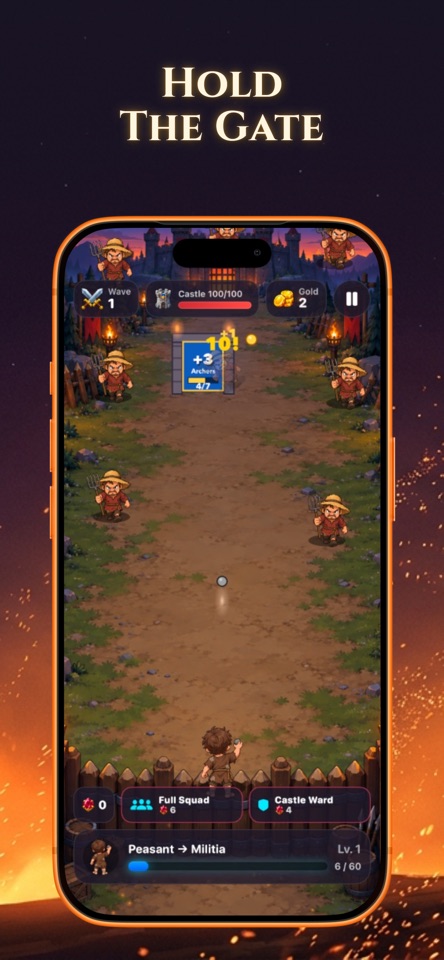
Controls pass: portrait twin-stick movement and aiming with mid-run buff picks. Camera passes: isometric castle defense shows the whole gate. Enemy design is the weak pillar to verify yourself, since v1.0.1 has zero reviews and no third-party audit exists. Progression is honest but unproven: seven hero classes and a blacksmith for permanent upgrades is the right structure, yet only your own runs will confirm the builds actually differ.
Which games fit a run-based mobile player?
If you want runs plus meta-progression on iPhone, start with castle-defense hybrids. Grow Castle! layers permanent upgrades across short waves. Heroes and Castles 2 mixes twin-stick combat with hero builds you respec between runs. Medieval: Defense & Conquest leans on unit progression rather than raw twin-stick controls.
Our honest self-test: Peasant to Paladin: Medieval Castle Defense passes on progression structure—seven hero classes, blacksmith permanent upgrades, and mid-run buff picks—and portrait-friendly controls. But v1.0.1 has zero reviews, so enemy-design polish remains unproven until players say so. Try it as a run-based alternative, not a proven one.
FAQ
Do twin-stick shooters work on a phone touchscreen without a controller?
Yes, but with tradeoffs. Virtual sticks map the two-thumb scheme directly: left thumb moves, right thumb aims and fires. Many portrait ports add auto-fire to cut execution load. True dual-stick aiming takes a few runs to learn, but it keeps the deliberate aiming the genre is built on.
Is a twin-stick shooter the same as a bullet hell?
No. Bullet hells are defined by dense, patterned bullet fields you dodge through narrow gaps. Twin-stick shooters are defined by the control scheme: one stick moves, the other aims. They can overlap, but independent movement and aiming is the defining trait.
What's the best twin-stick shooter for short portrait-mode sessions?
Castle-defense hybrids fit portrait best. Grow Castle! layers permanent upgrades across short waves, while Heroes and Castles 2 mixes twin-stick combat with hero builds. Peasant to Paladin is built for the same slot, though its v1.0.1 polish is unproven with zero reviews.
Can a castle-defense game count as a twin-stick shooter?
Yes, when the controls keep the split: one input moves you, another aims and fires independently. Castle-defense hybrids bolt wave holding and a base with HP onto that scheme.
Why do so many twin-stick shooters use roguelite progression?
Short runs, mid-run buff picks that compound into a build, and permanent upgrades between deaths give every session stakes without long commitments. Meta-progression also keeps the power curve moving.